
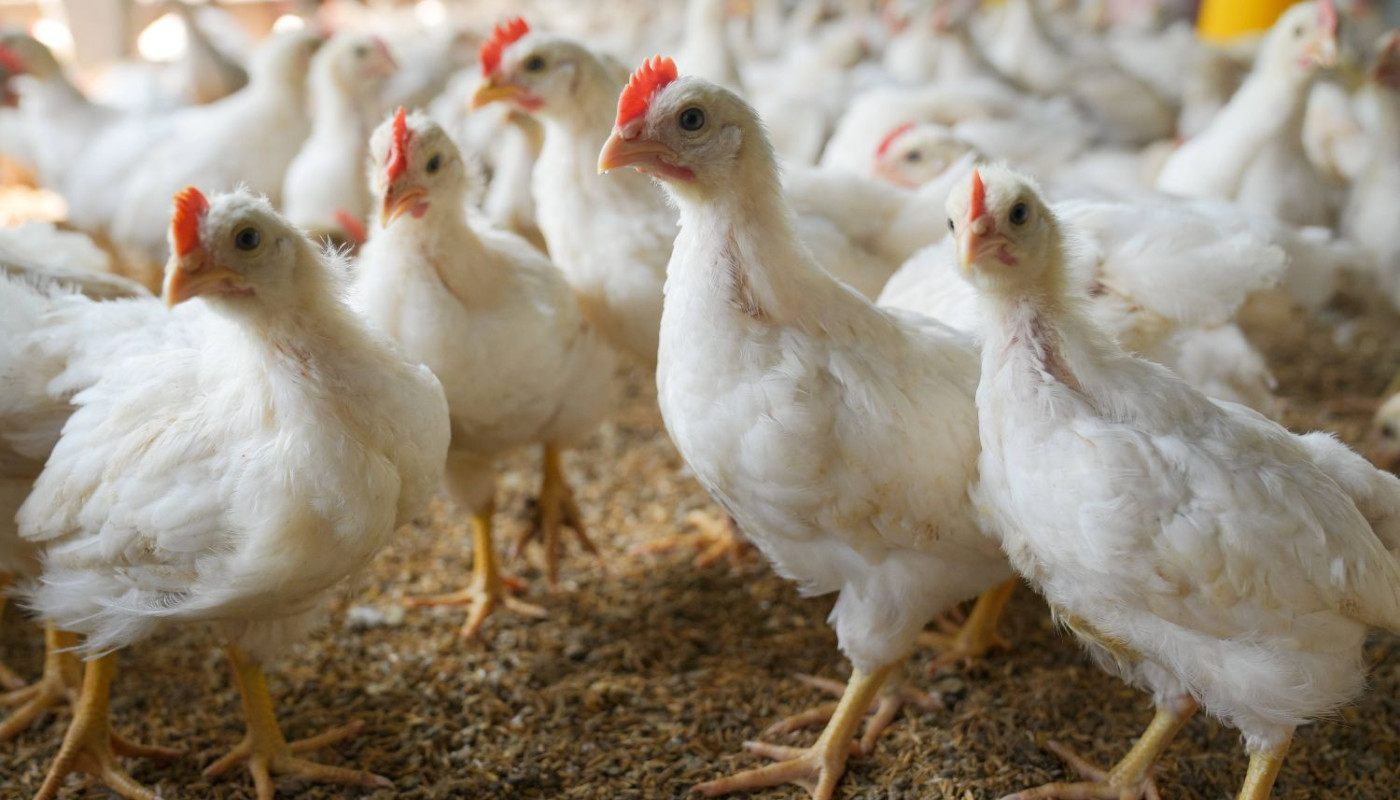
Few animal welfare demands are as practical and successful as the Broiler Initiative. With higher but achievable criteria for breeding, husbandry, and slaughter, it addresses the biggest animal welfare problems in modern chicken farming—and has found many supporters across Europe.
With Edeka's commitment to new animal welfare goals for broiler farming, the Broiler Initiative has reached another milestone in 2025. We are taking this opportunity to ask our president, Mahi Klosterhalfen, and Esther Erhorn, Director of Corporate Outreach, for their interim assessment and outlook.
What is the current status of the Broiler Initiative?
Esther Erhorn: »Over 110 companies in Germany have already joined the Broiler Initiative or set themselves goals that are in line with those of the initiative. That is a great success! We are particularly pleased that all the major food retailers are on board–Aldi Nord & Süd, Edeka & Netto Marken-Discount, Kaufland, Lidl, Rewe & Penny–as well as most smaller retailers, even hard discounters such as Norma. The influence of these companies, especially big players like Edeka, should not be underestimated.
However, implementation is often still lacking–announcements must be followed by action. Most companies have only achieved a low double-digit percentage of their target. Nevertheless, we can be satisfied. There are also some very positive examples.«
What is working particularly well?
Esther Erhorn: »Some companies have already completely converted their own brands, for example Aldi Nord & Süd and Tegut. The burger chain Hans im Glück was the first company to achieve a 100% conversion even before the target year. This is a real ray of hope, especially in the difficult restaurant chain industry!
With regard to the criteria of the Broiler Initiative, we can report that in Germany, electrical waterbath stunning is almost no longer used—a particularly error-prone method that we exclude in the Broiler Initiative. Companies that use the labels we recommend also usually automatically comply with the requirement for regular audits.«
What has been crucial to the success so far?
Mahi Klosterhalfen: »Persistence. We have made the Broiler Initiative our top priority and are investing a lot of time and money. We are using both to hold intensive discussions with companies in the food industry, implement campaigns, publish the Pecking Order report, and organize the Round Table, where we bring together decision-makers from business and politics to accelerate the transition.«
Is the Broiler Initiative the same as the European Chicken Commitment?
The Albert Schweitzer Foundation and other European animal welfare organizations have developed the criteria for the European Chicken Commitment (ECC), also known as Europäische Masthuhn-Initiative, based on scientific findings. Hundreds of companies across Europe have signed up to these criteria.
Since 2024, companies have also been able to participate by meeting the criteria of level 3 of the German husbandry type label Haltungsform and a few additional criteria. We have since combined this German extra way with the ECC and labels that meet comparable requirements under the name Broiler Initiative (Masthuhn-Initiative).
What impact can the Broiler Initiative achieve?
Mahi Klosterhalfen: »In Germany, more than 600 million broiler chickens are slaughtered every year. Our goals are to reduce this number—or at least prevent it from rising further—and to ensure that all chickens meet the minimum standards of the Broiler Initiative. There is still a lot to do before we get there, but the numerous commitments made have laid the foundation. Several large companies are currently in the midst of implementation.«
How do the conversations with companies proceed?
Esther Erhorn: »In most cases, we approach companies, inform them about the Broiler Initiative, and invite them to participate. However, it also happens that companies contact us and ask specifically how they can get involved.
The time between the initial contact and the commitment can vary. Sometimes it's only a few weeks. However, especially with large companies, it can sometimes take years before they can bring themselves to take this step.
Companies often ask us how much it costs to participate. We can quickly reassure them that it is completely free of charge on our part. Of course, the (additional) prices for goods with higher animal welfare standards are also an issue—the extra costs are a problem for some. Unfortunately, some companies are not willing to spend money on better animal welfare.«
Where do we see the biggest obstacles?
Esther Erhorn: »By far the biggest obstacle is product availability. Large food retailers in particular repeatedly report that they would like to make more changes, but there is not enough product on the market. Instead, the low level 2 of husbandry type label Haltungsform dominates.
The transition to level 3 is not progressing as quickly as desired, largely because winter gardens are mandatory here and permits are required for barn conversions, which are often difficult to obtain. In addition, the processing times for building applications are often very long. To improve this, we are lobbying at the political level to simplify the conversion or replacement of buildings for greater animal welfare. We are also working with producers, including those from abroad, to match supply and demand.
There needs to be even more movement in the large area of out-of-home catering. Although the top ten contract caterers are all on board, there are also many small companies, student services organizations, and independent caterers on the market that we cannot address. However, some have already approached us themselves. They have noticed that animal welfare is becoming increasingly important, especially among younger customers.«
What are the criteria of the Broiler Initiative?
The criteria of the European Chicken Commitment (ECC), the criteria of level 3 of the German husbandry type label Haltungsform plus additional criteria, and the criteria of selected labels (e.g., Kikok, Label Rouge) can be applied. There are minor differences between these options. The following improvements are always required:
- Exclusion of overbred chicken breeds
- Lower stocking density
- Enrichment material
- Elevated areas
- Regular audits by independent third parties
The detailed criteria of the ECC can be found here. A list of recommended labels and the criteria of Haltungsform 3 and additional criteria can be found on the German website of the Masthuhn-Initiative.
What role do political and economic developments play?
Mahi Klosterhalfen: »In addition to the difficult approval situation for barn conversions, the economic situation in Germany is also ›slightly tense‹. As a result of this and inflation, most people are not exactly flush with cash, which makes it difficult to raise animal welfare standards that affect prices. But the transition to the criteria of the Broiler Initiative does not cost a fortune, and in Germany, animal welfare is an issue that concerns most people at least to some extent, and often very much so. In addition, there is a growing consensus that the amounts of meat produced and consumed are too high in many respects. The Broiler Initiative fits in very well with the concept of ›less meat from higher standards‹.«
What are the next steps?
Mahi Klosterhalfen: »In the past, our main focus was on getting companies to commit to implementing the criteria of the Broiler Initiative. Now, only a few big names are missing—the two best known are McDonald's and Burger King. We still need to get these companies on board with the Broiler Initiative or, if necessary, motivate them with campaigns. At the same time, however, it is becoming increasingly important to help shape and accelerate implementation so that the majority of chicken farming is converted by 2030.«
What should companies that are still hesitant know?
Esther Erhorn: »Animal welfare is worthwhile! Of course, implementation and conversion can be challenging for a company at first. But in the long term, companies build more resilient supply chains and combat many problems associated with industrial factory farming and its current legal minimum standards (e.g., the spread of antibiotic resistance). Consumers also appreciate the transparent handling and expansion of higher animal welfare standards. A good communication strategy is very helpful in this regard.«
Thank you both very much, and good luck to all of us!
Support the Broiler Initiative here with your donation.