
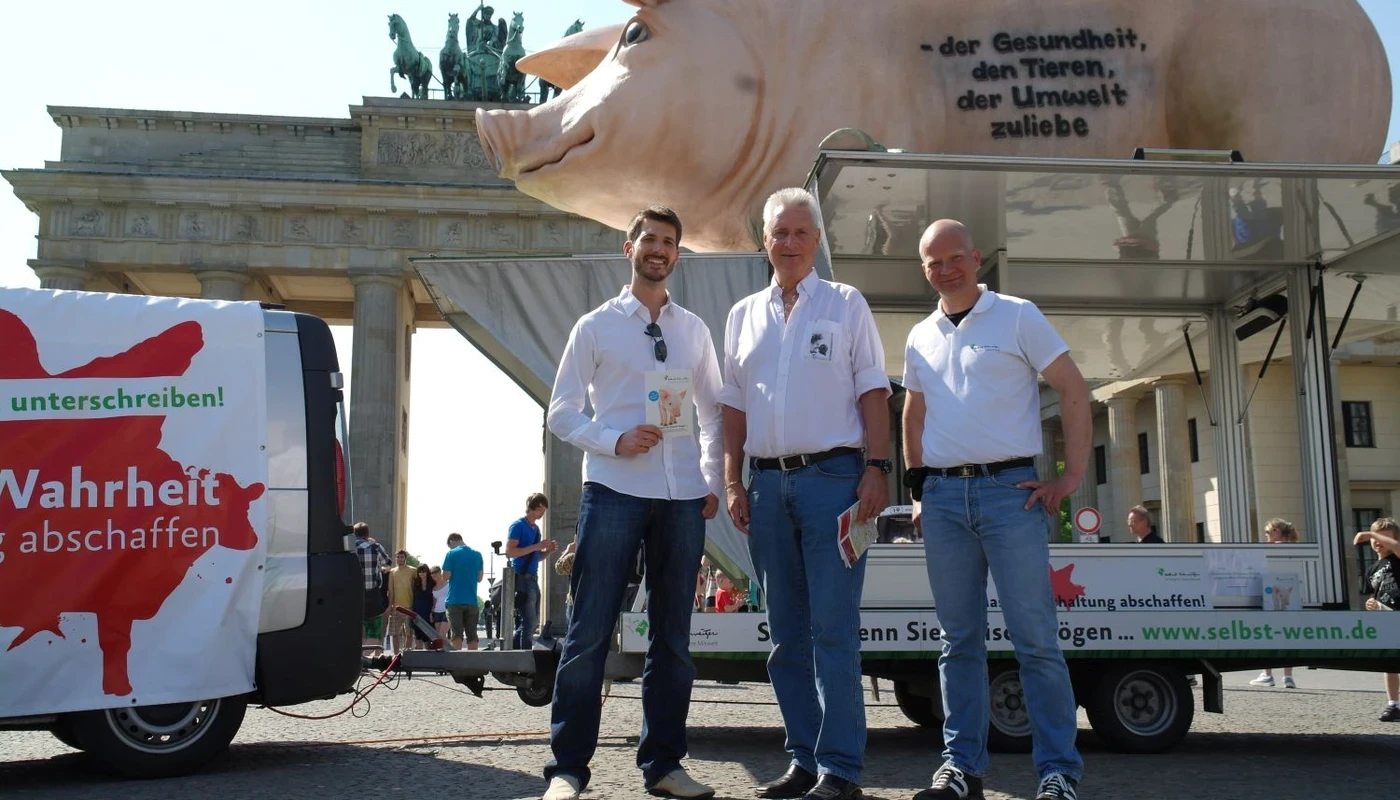
How It All Began: The Fight Against Cages
Sometimes it is hard to see the progress that has already been made – especially in the animal welfare movement. In the late 1990s, over 90% of all »laying hens« in Germany (around 35 million animals) were confined in tiny cages – so-called battery cages were the norm. The fact that cages are now virtually a thing of the past is thanks in large part to the Albert Schweitzer Foundation and its founder.
A Milestone for Animals
Former entrepreneur and lawyer Wolfgang Schindler was convinced that the law could protect animals – if applied seriously. He supported students who refused to participate in animal experiments on ethical grounds, took legal action against the European Patent Office over the patenting of the »cancer mouse«, and promoted the inclusion of animal welfare in the German constitution – which was actually successfully achieved in 2002.
As early as 1999, Wolfgang Schindler achieved a historic breakthrough: as the representative of the state of North Rhine-Westphalia, he persuaded the Federal Constitutional Court that the regulation in force at the time for so-called laying hens violated animal welfare law.
But he knew that a single success was not enough. To systematically reduce animal suffering, an organization was needed to pool resources and leverage the right legal, political, and economic tools. That is why he founded the Albert Schweitzer Foundation in 2000 – named after the physician and Nobel Peace Prize laureate Albert Schweitzer and inspired by his ethic of »reverence for life«.
A Student Changes Everything
At the same time, a business student was making a name for himself: Mahi Klosterhalfen. He had launched an animal welfare initiative at his university. By collecting thousands of signatures, he persuaded the student union to stop using cage eggs. And that was just the beginning: he connected with many other students online, explaining the concept of the »Cage-Free Cafeteria Initiative« to them and helping them replicate the success at their universities.
Mahi Klosterhalfen also contacted Wolfgang Schindler, who invited him to Munich, recognized his talent, and brought him onto the Foundation’s board. Soon after, the young activist took on responsibility – first as vice president, and after Wolfgang Schindler’s passing in 2013, as president. The strategic, impact-oriented approach that both share has shaped the Foundation ever since.
Germany Goes Cage-Free
The goal of the Albert Schweitzer Foundation was clear: to completely eliminate battery cages for »laying hens«. However, after the 1999 ruling, the egg industry responded not with genuine improvements but with so-called small group cages.
Wolfgang Schindler, however, had already set a precedent and convinced Aldi Nord to stop selling cage eggs. The idea was simple and effective: the fewer cage eggs are used, the less profitable battery farming becomes. Mahi Klosterhalfen also convinced other animal welfare organizations to join the »Germany goes cage-free« initiative. From his shared apartment in Düsseldorf, he began reaching out to more supermarket chains with the support of the new alliance – until the entire grocery retail sector was on board.
He moved to Berlin, built a small team for the foundation, and persuaded many food service businesses and food producers as well. In total, well over 100 companies were convinced to stop using cage eggs.
Helping Millions of Animals Together
The result: the share of battery-caged hens in Germany dropped from 90% to the current 4.3%. And once the economic relevance of battery farming had drastically declined, lawmakers followed suit: small group housing – the last legal form of battery cages – will be banned in Germany from January 1, 2026.
But our work does not stop there. Today, the Foundation is also successfully working to reduce the suffering of so-called broiler chickens and animals in aquaculture. The approach remains the same: we persuade companies to take responsibility, rely on dialogue – using societal pressure when necessary – and advocate for improvements to legal frameworks.
25 years after the founding, we are more convinced than ever: sustainable animal welfare works when people work together. Every signature, every donation, every email from you contributes to giving millions of animals a better life.